

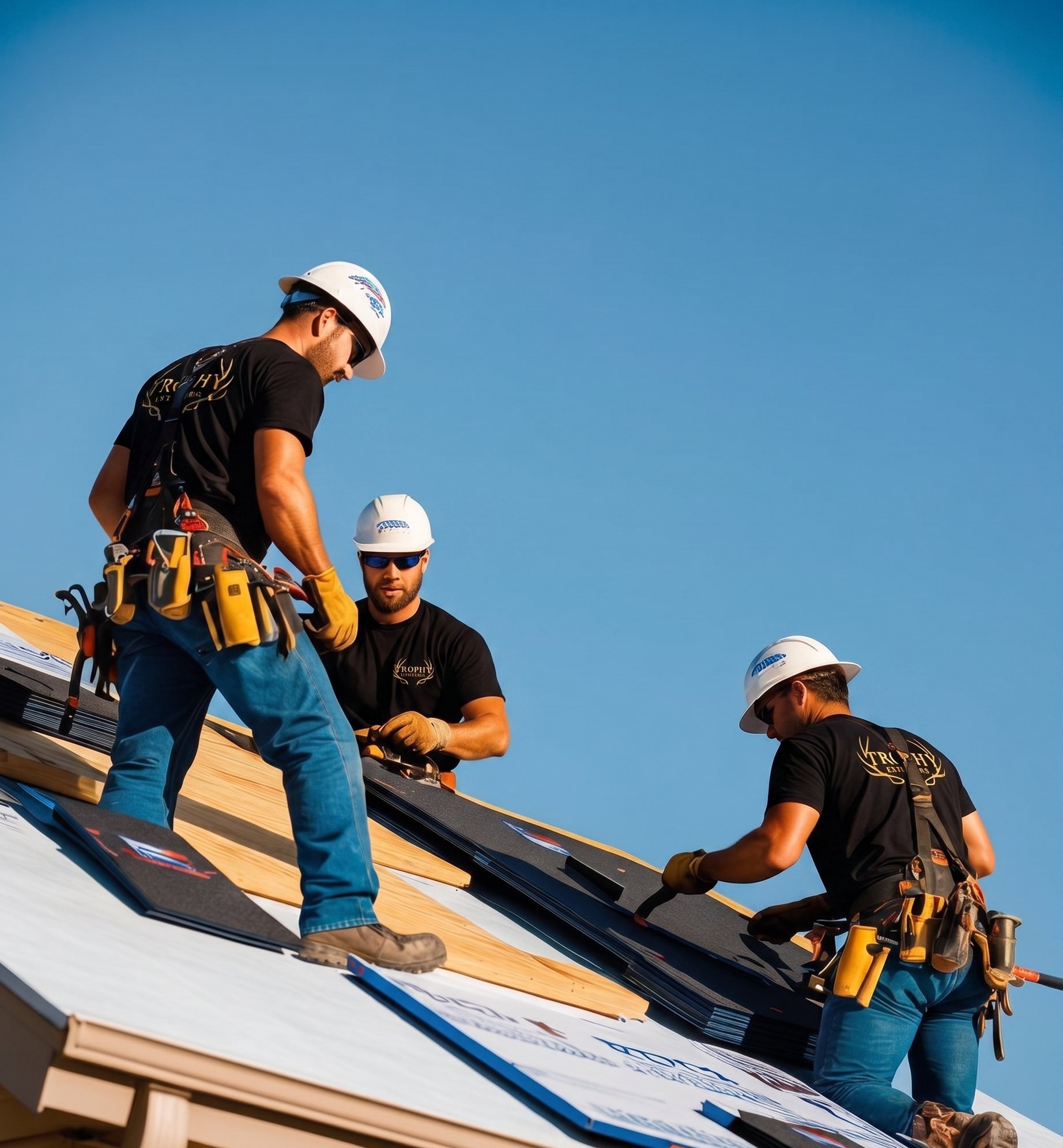
Pebble Creek is one of College Station's most established custom-home neighborhoods — more than 1,500 residences wrapped around the golf course, with price points that run from the mid-hundreds well past a million. Roofs here aren't a commodity purchase. They're a visible part of a home's architecture, they sit under an HOA's architectural standards, and they take the full brunt of Brazos Valley weather. Whether you're planning a replacement, dealing with a leak, or just want to know where your roof stands, here's what actually matters.
The material decision in Pebble Creek
The three materials we install most often on Pebble Creek homes are architectural asphalt shingles, standing-seam metal, and tile. Architectural shingles are the workhorse: they give you deep dimensional shadow lines, a 30-to-50-year product life, and Class 3 or Class 4 impact ratings that matter in hail country. Standing-seam metal costs more up front but shrugs off hail, reflects summer heat, and can outlast two shingle roofs — and its clean lines suit the neighborhood's more contemporary builds. Concrete and clay tile show up on the Mediterranean and Spanish-style homes; tile is beautiful and long-lived, but the underlayment beneath it does the real waterproofing and has to be installed by someone who does it regularly.
There's no single “best” answer — it depends on your home's architecture, how long you plan to stay, and your appetite for up-front cost versus lifetime value. What matters is that the material fits the home. A builder-grade three-tab shingle on a Pebble Creek estate doesn't just look wrong; it undercuts the value of the house.
HOA architectural standards come first
Pebble Creek holds its homes to architectural standards, which means a roof replacement usually isn't just your decision — it's a submission. Before we order a single bundle, we give you the manufacturer, product line, color, and profile so your architectural review committee has what it needs. Skipping that step is how homeowners end up tearing off a brand-new roof, and it's completely avoidable with a little paperwork up front.
What Brazos Valley weather does to a roof here
College Station sits squarely in hail-and-wind territory. Spring supercells drop hail that bruises shingles — damage you often can't see from the ground — and summer heat cooks asphalt until it goes brittle. On a golf-course lot with mature oaks, you also get abrasion from overhanging limbs and constant leaf litter in valleys and gutters that holds moisture against the roof. A roof that looks fine from the fairway can be quietly failing at the flashings and penetrations, which is why a professional inspection after a hail season is worth the hour it takes.
Don't overlook ventilation and decking
Two things separate a roof that lasts from one that fails early, and neither is the shingle. The first is attic ventilation: balanced intake at the soffits and exhaust at the ridge keeps superheated air from cooking the shingles from beneath and driving up your cooling bills through a Texas summer. The second is the decking — the plywood or OSB under everything. On a tear-off we inspect it and replace any soft, delaminated, or rotted sheathing, because nailing a new roof to bad decking guarantees problems. A quote that never mentions ventilation or decking is a quote hiding something.
What a quality replacement includes
For a Pebble Creek home, a proper scope reads: full tear-off to the deck, decking inspection and replacement as needed, synthetic underlayment, ice-and-water membrane in the valleys and around penetrations, new (not reused) flashing, balanced ventilation, and a thorough magnetic nail sweep of the lawn and drive afterward. Get that in writing so you can compare bids on equal footing rather than by bottom-line number alone.
Choosing a roofer for a home like this
Insist on a local company with a real College Station address, general liability and workers' comp coverage, and a written workmanship warranty separate from the shingle manufacturer's warranty. Ask for references on comparable homes and be wary of anyone who pressures you to sign or offers to “handle” your insurance deductible — that's illegal in Texas. Trophy Exteriors is headquartered here; our owners live in the Brazos Valley, and our warranty means something because we'll still be down the road in ten years. That's the standard you should hold anyone to — including us.
Frequently Asked Questions
What roofing material is best for a Pebble Creek home?
Most Pebble Creek homes are well suited to architectural (dimensional) asphalt shingles or standing-seam metal. Architectural shingles balance cost and a high-end look, while standing-seam metal offers 40+ year life and excellent hail performance. Some estates use concrete or clay tile, which requires a roofer experienced in tile underlayment and flashing.
Does Pebble Creek's HOA restrict roof colors or materials?
Pebble Creek maintains architectural standards, so color and material changes typically need approval. We provide the manufacturer, product line, and color samples your architectural review committee will ask for before we start.
How much does a new roof cost in Pebble Creek?
It depends far more on your specific roof than the neighborhood. Size, pitch, material, and complexity drive the price — a steep, multi-gable roof costs more per square than a simple one, and metal or tile can be two to three times the cost of architectural shingles. The only accurate number comes from an itemized, on-site estimate.
How long will a new roof last in College Station's climate?
Architectural shingles typically last 20–30 years here (often shorter with hail), Class 4 impact-resistant shingles a bit longer, and standing-seam metal or tile 40–75 years when installed and ventilated correctly.
Need a straight answer about your roof?
Free inspections, honest estimates, and a local team that answers the phone.
Get a Free Inspection


